
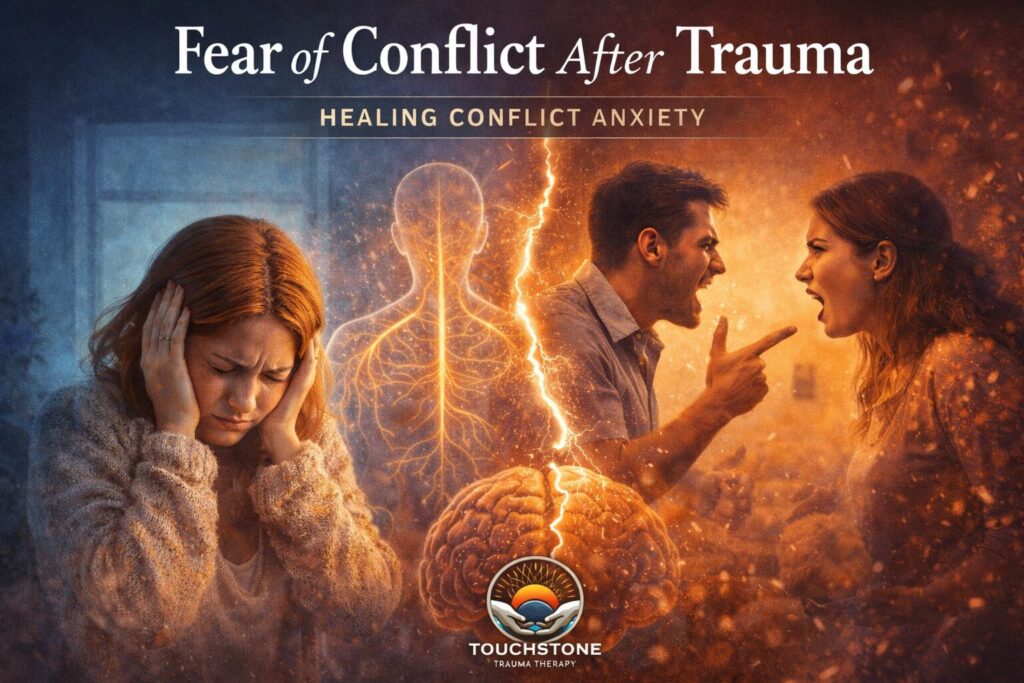
Why Fear of Conflict After Trauma Feels So Threatening
Fear of conflict after trauma can make even small disagreements feel threatening, triggering panic, shutdown, or the urge to disappear — not because something is wrong with you, but because your nervous system learned to associate conflict with danger.
Whether we meet in person in Montrose or connect by telehealth from Glendale, Burbank, Pasadena, or Los Angeles, I often hear clients say:
- “I avoid conflict at all costs.”
- “Even a small disagreement makes me anxious.”
- “I shut down when someone raises their voice.”
- “I agree just to keep the peace.”
- “I replay arguments in my head for days.”
If conflict feels dangerous to you, there’s usually a reason. Most often, your body is responding to old experiences that taught you anger, tension, or emotional intensity weren’t safe.
Why Conflict Can Feel So Threatening
Typically, the fear of conflict starts in earlier environments where disagreements weren’t handled with care. For example, you may have grown up in a home where:
- Caregivers yelled, exploded, or withdrew affection
- You were punished for expressing emotions
- Voices were raised often
- Love felt conditional
- Disagreements led to silence, blame, or rejection
- You had to stay small to stay safe
- You learned that peace depended on your compliance
In those settings, conflict wasn’t just uncomfortable — it was dangerous. As a result, your nervous system learned to treat tension as a threat.
How Fear of Conflict Shows Up as an Adult
Even when the current relationship is safe, your body may still react like it’s back in the old one. Consequently, fear of conflict often shows up as:
- Avoiding difficult conversations
- Saying “it’s fine” when it’s not
- Suppressing needs or feelings
- Apologizing even when you did nothing wrong
- Shutting down emotionally
- Feeling anxious before speaking up
- Overthinking every disagreement
- Trying to fix everything immediately
- Feeling responsible for keeping everyone calm
So, if you struggle with conflict, it doesn’t mean you’re “bad at communication.” Rather, it means your body learned a survival strategy that once helped you.
What Your Nervous System Is Doing During Conflict
Understanding how the nervous system responds to threat is a key part of healing, which is why learning about nervous system regulation can be so helpful.
With support, fear of conflict after trauma can soften, allowing relationships to feel safer and more secure over time.
Conflict can activate your body’s threat response automatically. For instance, you might notice:
- Heart racing
- Shallow breathing
- Tight chest
- Stomach knots
- Feeling frozen or foggy
- Going blank mid-conversation
- Wanting to escape, shut down, or people-please
This happens because your brain associates conflict with danger — even when the present situation is not actually dangerous. In other words, it’s not a personal weakness. It’s physiology.
Two Common Trauma Patterns: Shutdown vs. Peacekeeping
Often, people fall into one of these patterns during conflict:
1) Shutdown (Freeze)
You go quiet, disconnected, or blank. Then, afterward, you might replay the whole conversation and feel frustrated that you didn’t say what you meant.
2) Peacekeeping (Fawn)
You agree quickly, apologize, or smooth things over to end the tension. Later, however, you may feel resentful, unseen, or emotionally exhausted.
Sometimes people switch between both. Either way, your nervous system is trying to keep you safe.
How Healing Happens in Therapy
Healing the fear of conflict isn’t about forcing yourself to “tough it out.” Instead, it’s about helping your nervous system learn that disagreement doesn’t automatically equal danger.
At Touchstone Trauma Therapy, I support clients with:
Somatic Therapy
First, we work with the body. This helps you stay grounded when emotions rise, rather than going into panic or shutdown.
Parts Work (Internal Family Systems)
Next, we identify the parts of you that fear conflict, avoid it, or try to manage it. Then, we help those parts feel safer and less reactive.
Inner Child Work
Additionally, we support the younger part of you that learned conflict meant rejection, punishment, or abandonment.
EMDR Therapy
Moreover, EMDR can reduce the emotional charge tied to earlier experiences that wired conflict to fear.
Attachment-Focused Therapy
Finally, therapy can help you practice safer communication and healthy relational repair — because conflict isn’t the end of connection. In healthy relationships, it’s often the beginning of deeper understanding.
Practical Tools That Can Help Before and During Conflict
Even small shifts can make a big difference. For example:
- Pause + exhale first. A longer exhale signals safety to the nervous system.
- Use a grounding anchor. Press your feet into the floor or hold something cool in your hand.
- Name what’s happening. Saying “I’m getting activated” can reduce shame and slow the spiral.
- Ask for time. “I want to talk about this, and I need a few minutes to settle first.”
- Focus on one point. Staying on one issue prevents overwhelm and shutdown.
Over time, these tools help your body learn that conflict can be survivable — and even manageable.
Signs You’re Healing Your Fear of Conflict
Healing conflict anxiety is subtle, but it’s powerful. You may notice:
- Feeling calmer during difficult conversations
- Speaking up without panic
- Taking a moment before reacting
- Allowing yourself to disagree
- Feeling safer expressing needs
- Not assuming the worst
- Recovering faster after tension
Eventually, you begin to trust that conflict doesn’t automatically mean loss, danger, or disconnection.
If fear of conflict after trauma overlaps with people-pleasing or relationship anxiety, you may also find it helpful to read more about setting boundaries without guilt and relationship anxiety after trauma.
You Deserve Relationships Where Conflict Is Safe
Healthy relationships aren’t perfect — they include disagreements, misunderstandings, repairs, and moments of tension. However, they also include safety, respect, and the ability to reconnect.
If conflict has always felt scary to you, that makes sense. You adapted to environments that didn’t protect you. Still, with support, your body can learn something new: conflict can be safe, gentle, and even healing.
Touchstone Trauma Therapy
2441 Honolulu Ave, Suite 120
Montrose, CA 91020
(626) 824-8572
Serving Montrose • Glendale • Burbank • Pasadena • Los Angeles • Telehealth/Remote Video Therapy Across California