
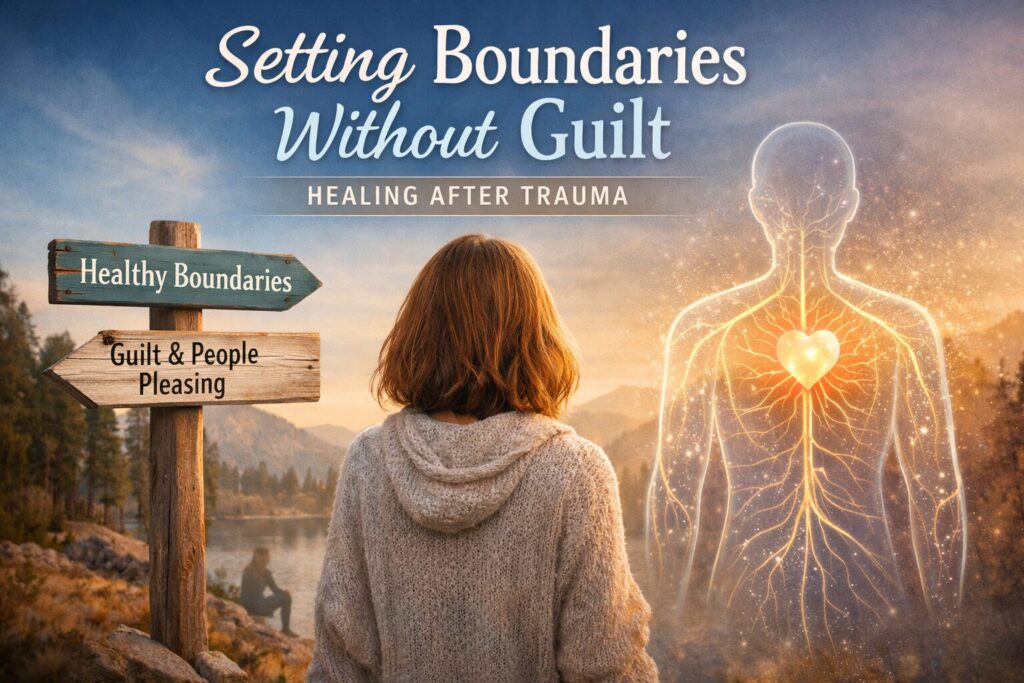
Why Setting Boundaries Without Guilt Feels So Hard After Trauma
For many trauma survivors, boundaries can feel confusing, scary, or even “wrong.” You might know you need them — however, the moment you try to set one, guilt hits your chest, your stomach tightens, or your mind starts telling you you’re being difficult.
Whether we meet in person in Montrose or connect via telehealth from Glendale, Burbank, Pasadena, or Los Angeles, I hear this all the time:
- “I feel guilty saying no.”
- “I don’t want to disappoint anyone.”
- “I’m scared they’ll be mad if I speak up.”
- “I always put others first — I don’t know how not to.”
- “If I set a boundary, I feel like I’m doing something wrong.”
To be clear, this isn’t a personality flaw. Instead, it’s a trauma response.
Why Boundaries Feel So Hard After Trauma
If you grew up in a home where your needs weren’t supported — or where expressing them caused conflict, rejection, anger, or punishment — your nervous system likely learned:
- “My needs don’t matter.”
- “I should stay quiet to be safe.”
- “Speaking up leads to consequences.”
- “If I upset someone, connection will be taken away.”
Back then, those beliefs were protective. Unfortunately, in adulthood, they can keep you stuck in patterns that leave you drained, resentful, or invisible.
Signs You Struggle With Boundaries
Boundary injuries show up in everyday behaviors. For instance, you may notice yourself:
- Saying “yes” when you want to say “no”
- Feeling responsible for everyone’s feelings
- Over-explaining yourself
- Avoiding conflict at all costs
- Taking on too much at work or at home
- Feeling guilty for resting
- Feeling drained by relationships
- Feeling resentful but staying silent
- Trying to keep everyone happy
- Feeling like you “owe” people access to you
Importantly, these behaviors were survival skills. In other words, they helped you get through environments where you didn’t feel safe having needs.
Why Boundary Guilt Feels So Intense
That sharp guilt you feel when trying to set a boundary is often your nervous system going into a stress response. In fact, your body isn’t reacting to the present moment — it’s reacting to old conditioning.
If your brain learned that boundaries = danger, then even a calm “no” can feel like a threat internally.
Therefore, healing isn’t about becoming “harder.” Instead, it’s about retraining your nervous system to understand: boundaries = safety.
What Healthy Boundaries Actually Look Like
Healthy boundaries are not walls or ultimatums. Rather, they’re clear, respectful statements that protect your time, energy, and emotional wellbeing. For example:
- “I can’t make it tonight.”
- “I need some quiet time.”
- “I’m not available for that.”
- “That doesn’t work for me.”
- “I need a break.”
- “I’m not comfortable with this.”
- “I prefer if you don’t speak to me that way.”
Also, you don’t need a long explanation. A complete sentence is enough.
Learning how to set boundaries without guilt is not about being selfish — it’s about teaching your nervous system that your needs are allowed.
How Therapy Helps You Build Boundaries
Learning how to regulate your nervous system plays a key role in healing trauma and boundary guilt, which is why understanding nervous system regulation can be so helpful.
At Touchstone Trauma Therapy, we focus on the fear underneath the guilt — because that’s usually where the real work is. Depending on what you need, therapy may include:
Somatic Therapy
First, we tune into how boundary fear shows up in the body (tight chest, racing heart, stomach drop) and help your system settle.
Parts Work (Internal Family Systems)
Next, we support the parts of you that believe setting limits will lead to rejection, anger, or abandonment.
EMDR Therapy
Additionally, EMDR can help reprocess memories that taught you it was unsafe to have needs.
Attachment-Focused Therapy
Meanwhile, the therapeutic relationship becomes a place to practice safety, repair, and healthy relational boundaries.
Nervous System Regulation Skills
Finally, we build strategies to soothe the guilt response so it doesn’t run the show.
Over time, boundaries get easier because your nervous system stops treating them like danger.
If setting boundaries without guilt feels tied to fear of abandonment or emotional overwhelm, you may also find it helpful to read more about relationship anxiety and fear of conflict after trauma.
Small Steps to Start Setting Boundaries (Without Panicking)
You don’t have to overhaul your entire life at once. Instead, start small:
- Delay instead of saying yes immediately
Try: “Let me get back to you.”
This creates space to check in with yourself. - Practice in low-stakes situations
For example, choose the restaurant, pick a time, or state a preference — small “rights to choose” add up. - Use simple “I” statements
“I’m not available.”
“I need a moment.”
“I’m going to pass.” - Set time boundaries
“I can talk, but I only have 10 minutes.”
That way, you stay connected without overgiving. - Start with safer people
If someone respects your “no,” you build confidence. If they don’t, you get information.
What Healing Boundaries Feels Like
As you grow, you may start to notice:
- Less guilt and more confidence
- Feeling more in control of your time and energy
- More honest, grounded communication
- Choosing relationships that respect your needs
- More self-respect
- Feeling calmer when you say “no”
- More space in your life for what matters
In short, boundaries create safety — both internally and externally.
You Deserve to Have Needs
If boundaries feel scary, it’s often because no one taught you they were allowed. You deserved emotional safety, consistency, and respect. And you deserved people who cared about your needs — not just your compliance.
The good news is: it’s not too late to learn this. Step by step, your nervous system can begin to trust that you’re allowed to take up space.
With support, setting boundaries without guilt becomes less about fear and more about self-respect.
Touchstone Trauma Therapy
2441 Honolulu Ave, Suite 120
Montrose, CA 91020
(626) 824-8572
Serving Montrose • Glendale • Burbank • Pasadena • Los Angeles • Telehealth/Remote Video Therapy Across California